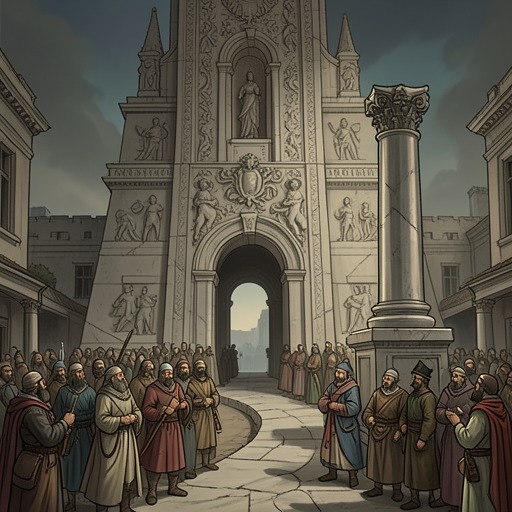
Architecture is the Great Book of Humanity
The Hunchback of Notre DameArchitecture is the Great Book of Humanity is the book’s central metaphor for architecture as a record of human thought made visible and durable. From early monuments to the medieval city, buildings preserve memories and give material form to the beliefs and social orders of their makers; the rise of printing then shifts the principal medium of collective expression from stone to paper.
Architecture as Humanity’s Record
The argument describes architecture as more than shelter or construction. Down to the fifteenth century, it was humanity’s chief register: complex ideas, religious laws, and popular beliefs could be inscribed in monuments and passed on in a form more lasting than speech or manuscript. The book calls this medium “the great book of humanity,” treating buildings as pages on which successive generations left their understanding of the world.
In this account, architecture begins with the need to preserve memory. When the accumulated recollections of early peoples could no longer be carried securely by speech, they were fixed in the landscape beneath monuments. The earliest structures become a kind of alphabet: an upright stone functions as a letter or hieroglyph, carrying ideas in a material form that can outlast the people who made it. Building is therefore both an act of construction and an act of transmission.
The metaphor extends from individual structures to whole historical worlds. The book presents architecture, from the earliest monuments through the cathedral of Cologne, as a record in which religious symbols and human ideas have their own pages and monuments. Its durability is part of its meaning: a manuscript can be destroyed by fire, while the destruction of a constructed record requires upheavals on the scale of social or terrestrial revolution. Stone makes cultural memory difficult to erase, though not impossible.
Belief, Society, and the Forms of Buildings
Architecture records not only what people believe but also how ideas take shape. The argument presents buildings as forms in which a generating idea is made legible: in the example of Solomon’s temple, the sacred word is expressed through the structure itself and its successive enclosures. The chosen site matters too. A temple raised on a mountain and a sanctuary carved into the earth embody different physical approaches to religious expression; setting and form together make an idea visible.
The book also connects architecture with changes in social order. It states, “All civilization begins in theocracy and ends in democracy,” and reads this movement as something written in architecture. In this interpretation, buildings register more than religious doctrine: they preserve the changing organization of human society. The metaphor is thus historical as well as commemorative. A monument can be read for the beliefs and collective arrangements that produced it, even when those arrangements have since changed.
Paris as a City Written in Stone
The account of Paris makes the metaphor concrete by treating the city’s growth as a legible history. Paris began on the island of the City, whose shore served as its first boundary and the Seine as its first moat. For centuries the city remained island-bound, entered by two bridges protected by the Grand and Petit Châtelet, which served as both gates and fortresses. As settlement crossed the river, successive walls and towers enclosed a larger area; expanding houses gradually overflowed those defenses, and the memory of earlier boundaries survived after the structures themselves had disappeared.
By 1482, Paris comprised three connected parts: the City, the Town, and the University. Their streets formed a dense, irregular network, yet major routes crossed the three districts and the Seine carried people between them. From above, this plan could be read as both fragmentation and unity: distinct urban parts joined into a single body by streets, bridges, and movement. The city’s physical arrangement retained the evidence of its growth, from island settlement to expanding capital.
The tower view of Paris at the time gathers that record into a single panorama. Roofs, chimneys, bridges, streets, spires, and bell towers appear together, from small carved houses to the royal Louvre. But architecture is also experienced from within. In the dark lanes around the Saints-Innocents, Pierre Gringoire loses his way in an apparently self-returning maze of alleys, squares, and closed courts. The contrast between the elevated survey and the confused street-level path shows how the built record can be at once a pattern visible from above and a difficult environment encountered on foot.
The Built Record in Use
Architecture in the book is not only something to interpret at a distance; it shapes what can be seen, reached, and endured. Medieval buildings have an underground dimension as well as an elevated one: their chambers, galleries, and staircases extend into the ground, and the cellars of palaces and fortresses can become prisons. The building’s visible grandeur and its hidden spaces belong to the same material structure, which can shelter, confine, or bury human lives.
The tower of Notre-Dame provides another practical perspective on the city. From its height, Quasimodo watches Paris and detects movement along the quay by the changing line of the parapet against the water. The tower is both part of the city’s accumulated architectural record and a position from which its present activity can be observed. In this way, the metaphor encompasses not just the meanings buildings preserve, but also the vantage points and boundaries through which people experience urban space.
Stone and Print
The book’s historical argument turns on a change of medium. For centuries, architecture had served as the principal public register of collective thought; in the fifteenth century, printing begins to carry that work. The new medium is easier to produce, less costly, and able to travel farther. Thought consequently flows into books, and architecture ceases to be the dominant social and collective art. The claim is not that buildings stop being made or lose all value: the text allows for exceptional monuments in the age of printing, while distinguishing them from the great works produced collectively in architectural epochs.
The transition is expressed as the coexistence of “two books, two registers, two testaments: masonry and printing; the Bible of stone and the Bible of paper.” The stone record remains worthy of reading and admiration, but it no longer holds an exclusive place as humanity’s principal means of giving lasting form to thought. The metaphor therefore carries both a sense of loss and an enlarged historical view: printing changes how collective memory is made, while architecture continues to preserve the earlier centuries in material form.